
Managing money when you have an irregular income each month is a difficult situation to find yourself in.

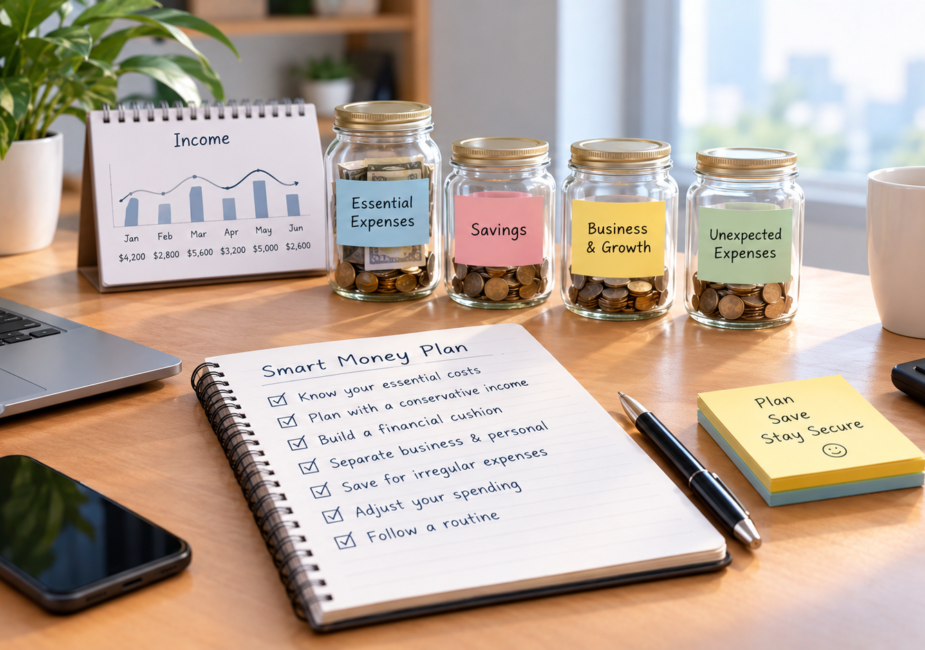
Money management is more difficult if there are fluctuating monthly incomes. Those who are on a freelance, small business, commission, or any other temporary basis may make large sums of money in one month and much less the following month. When they have an average income, it can be challenging to make their financial choices every day.
The answer is not necessarily to have a monthly income that is the same amount. Rather, the finance system must be flexible to meet the needs of individuals with erratic income. Knowing what necessary costs are, will learn to plan around lower income periods and create a financial buffer to facilitate financially.
Know what your essential monthly expenses are.
The first thing you need to do is determine the amount of funds required for basic living expenses. These can include the cost of housing, food, electricity, transportation, education, Internet and required medical expenses. This will vary according to your household and location.
Look at the last three months of your spending to determine the minimum amount that your household needs. Make sure there is enough money for the things that are necessary and not for entertainment and shopping out of the ordinary.
That separation is significant as your earnings may not be enough to cover your spending desires. Once you know what your necessary monthly expense is, you have a helpful base to make your monthly saving decision when you get paid.
Approach your budget with a conservative income.
One of the most common budgeting pitfalls is to budget for the best month of the year. If income is substantial, they might spend more or make promises that are hard to keep up later.
The better method is to use a number that is conservative and based on your past income. If your income fluctuates, consider several months of records, and determine an amount that is reasonable to expect in a typical month or in a month when your income is not as high.
Use this estimate to plan the necessary costs first. If you make more, use that money to increase your savings, save for expenses you are expected to make in the near future, or save for unexpected expenses.
This approach allows for a more realistic budget since it will not be based on the expectation that each month will be equally profitable.
Put in place a financial cushion for lean months
A rainy day fund is particularly helpful if your income is irregular. A lack of savings, a late payment from a client, fewer customers or a short-term work stoppage can make normal bills hard to pay without savings.
Don’t start saving for a big goal until you can save a lot. A small savings jar can create some breathing room if income doesn’t show up on time. Over time, save enough so that you can cover several months’ worth of bills and other expenses, depending on your bills and how stable your income is.
Separate this money from spending to make it less tempting to use for regular purchases. Depending on the options and conditions of the savings account, you might want to open a savings account that allows for access when you need it.
The objective is not to foretell all financial issues. It is for having to deal with unscheduled expenses or a short-term lack of income.
Distinguish between business and personal expenditure.
The small business owner or freelance worker may get paid directly into the same account that they pay their bills with. This can make it hard to figure out what’s available for your own spending and what’s being used to pay the bills.
An entrepreneur, for instance, may accept a big customer payment, and believe that the entire sum can be used. However, some of this money could be required for supplies, operating expenses, tax or future business commitments.
Separate business income and personal spending as much as possible. Maintain a record of money received, business expenses and outstanding payments. Once you’ve spent what is necessary to keep the business going, determine how much can be safely moved into your personal budget.
This is an easy practice that helps you to be more aware of your finances and avoid making unnecessary spending commitments after a good business month.
Save money for those expenses you don’t expect monthly.
There are some costs that are foreseeable but not recurring monthly. Unexpected expenses like annual insurance payments, school fees, equipment replacement, vehicle maintenance and seasonal household expenses can throw off a budget.
Rather than paying these bills as they come, plan ahead for these expenses over time to see how they are likely to affect your finances. If the payment is to be made in a couple of months, break the sum that is to be deposited into smaller goals that match the time period.
This can be especially helpful for those who don’t earn a steady paycheck, as the big bills might fall at the same time as low earnings. Planning for them in good times lessens the need for borrowings or emergency savings for expenses that might have been anticipated.
Modify the amount of money spent when income is altered.
There should be a flexible budget, changing with the circumstances. In a more robust period, it can be possible to save more, reduce debt or save for future costs. It is possible the non-essentials have to be cut for the duration of a less strong month.
Check the money that’s coming in and going out frequently, rather than at the end of the month and finding you’re short! Just a weekly review can help you see how much money you have available before your bills are due and catch issues early.
Don’t make a lifelong change in your lifestyle because of a single profitable month. Think about how much you are earning and are you able to afford those regular costs even if you aren’t as busy?
Financial stability may result from managing commitments instead of attempting to foresee the amount of funds that is to be received.
Establish stable routines
When there is an irregular income, it is much easier to manage finances when there is a regular routine to financial decisions. Make sure that you put money into your bank exactly as it comes in, track your spending, set aside any money you can to pay your bills, and save some as well.
It can also assist in following up on unpaid invoices, sustaining connections with reputable customers and finding methods to cut dependence on a solitary income stream. These measures can make cash flow easier, but won’t guarantee that income will stay the same.
Most of all, do not compare your financial success with anyone else who has a different income, responsibilities / situations. A good money management plan is one that is realistic for your situation and will be followed for the long-term.
Budgeting Tips Emergency Savings Irregular Income Money Management Personal Finance
Last modified: October 14, 2026