

Will Your Crypto Wallet Become Your Digital Identity in the Future?

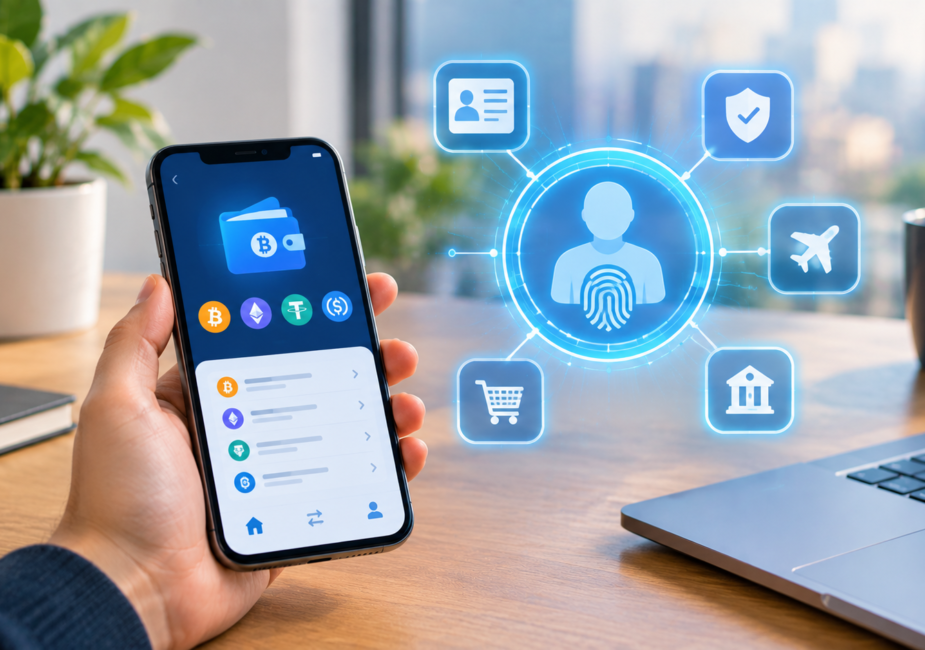
People typically think of the wallets for cryptocurrency as a place to store and send digital currency. However, blockchain technology could be used for more than just financial transactions. One developing idea is to use blockchain-based wallets as a way to manage digital identity.
Users typically have an online presence in several different services today. An individual can have distinct accounts for banking, shopping, education, work and social websites. Information about the user can be collected and stored by each of the services. The decentralized identity concept seeks to do this differently by providing more control over digital credentials and content to the individual.
Although the concept is still in its nascent stage, it may prove to be an intriguing component of the broader cryptocurrency and blockchain landscape.
What is Decentralized Identity?
Digital identity model that lessens reliance on a single organization to hold a person’s identity and credentials. Users can store some of their identity data on their own, and show them when needed, rather than storing all of it within a single company’s system.
The blockchain or other technology can provide proof of authenticity for a credential without the original information having to be publicly available.
According to the existing documentation of the Ethereum blockchain, decentralized identity is a method that can enable users to create, manage and own identifiers and attestations without being completely dependent on centralized third parties.
This is a new perspective on online identity. Rather than users having to enter all the information needed to create a full profile of a person on every site, users may be able to enter only the information needed for a specific interaction.
So, why would people need this?
Let’s take an example that is very straightforward. A site might require to determine if a customer is of a certain age or not. In a traditional system, the user could be asked to present a document with his/her name, date of birth, address, photograph, and other data.
However, the website might only require one fact – whether the person is of the required age.
A decentralized identity system might even be able to let the user prove that fact without having to release all of the information in the original document.
This is especially significant as online services become more dependent on authentication methods for their users, and want to minimize the gathering of information that isn’t necessary.
Crypto Wallets May Play a Greater Part.
Digital assets are already controlled by the user with cryptographic keys in crypto wallets. The same wallet technology can be used to store verifiable credentials in the future.
A wallet might include evidence of qualifications, memberships, ownership or other verified information. The user would then be able to decide when to show a specific credential.
This does not imply that all cryptocurrency wallets will have to be ID wallets. Various systems, standards, regulations and applications are still in development.
The key is the wallet might be more than just a home for digital cash. It may be a personal entryway to engage with a range of digital services.
Privacy is added to the design process.The Privacy becomes a part of the design process.
More choices over one’s identity doesn’t necessarily address all privacy issues
There is a need to carefully design a digital identity system. Information should not be unnecessarily exposed, and users should know what and who they should share the information with.
This is where privacy enhancing technologies can come in. Bank of Italy’s recent research focused on methods to reconcile the privacy aspect with the requirements of auditability and regulation of digital payment systems.
The challenge is achieving a balance that is both practical and feasible: Users need privacy, but organizations might have legitimate need to verify the information.
How Web Services Can This Affect?
When decentralized identity systems start to be compatible, consumers may not have to develop a fresh identity profile for each service.
Any individual could present an authenticated credential as proof of a qualification to an employer, as a membership to an organization, or as a proof of a particular personal attribute to an online service.
The benefit wouldn’t necessarily be in the form of visible blockchain technology. Indeed, the best systems can make the technology virtually invisible to everyday users.
Individuals may just have a quicker and more regulated manner of exchanging information online.
There are still challenges to come
Decentralized identity is not a fully developed technology.
Communication between systems is required. There is a need for organizations to be able to issue and verify credentials. Users should be able to easily recover their access if they misplace a device or key. Clear laws and policies for acceptance of digital credentials by governments and businesses are also needed.
A blockchain doesn’t automatically make the organization it was issued by honest and qualified, but it can verify that the credential has not been changed.
What this implies is that there is still a need for trustworthy institutions, standards, and governance to create identity systems.
A Different Future for Digital Identity
The cryptocurrency market can be talked about in terms of coins, exchanges and trading. Decentralized identity is another aspect of blockchain technology.
The longer term vision isn’t merely the act of adding personally identifiable data to the blockchain. It is providing better means of controlling verified digital credentials and enabling services to verify specific information if required.
If the technology, standards and regulation come to fruition, crypto wallets could be a helpful tool in more than just managing digital assets.
The interesting question going forward is not whether blockchain can supplant the existing identity systems. It could be about whether blockchain can provide consumers with a more flexible means of establishing themselves as the real person they are, without revealing the needless details.
Blockchain Technology Crypto Wallets Decentralized Identity Digital Identity Digital Privacy
Last modified: October 1, 2026




[…] Ethereum in particular is critically important, meaning an upgrade to the underlying consensus mechanism will have far-reaching implications for the entire associated blockchain environment, including apps, services, smart contracts, assets, and more. […]
[…] from cryptocurrency. It is being researched for use to enhance privacy and verification, and for digital systems such as voting, where individuals must prove something without revealing unnecessary personal or […]