

Why Commercial Solar and Battery Storage Are Becoming a Business Decision, Not Just an Energy Upgrade

A change in the way companies think about power
For years, a commercial solar installation was often presented as a straightforward way to lower an electricity bill. That explanation is no longer enough for many businesses. A restaurant with refrigeration, a warehouse with around-the-clock operations and a manufacturer running sensitive equipment all have different reasons to care about electricity.
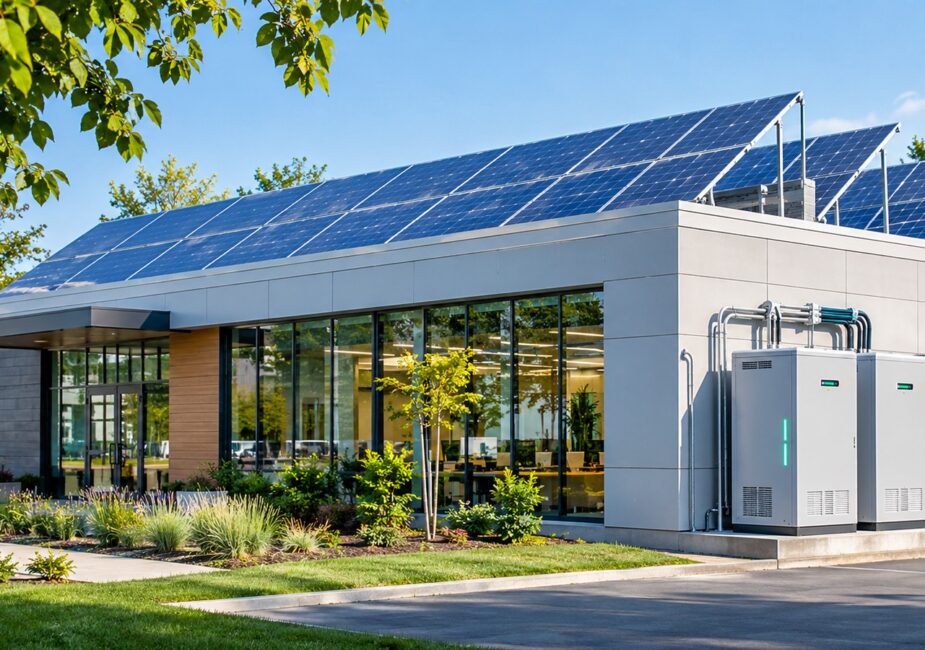
Their decisions increasingly involve reliability, operating schedules, financing, building ownership and exposure to utility tariffs. Solar panels can produce electricity during daylight, while battery systems can shift some of that energy to a different time or provide limited backup during an outage. The business case depends on how these capabilities match the customer’s actual operations, rather than on the appearance of the equipment or the headline size of the system.
Understanding the economics
A useful starting point is the customer’s interval electricity data, ideally covering a full year. Monthly bills alone may hide the hours when demand peaks or when electricity is most expensive. A battery may be financially valuable at one property because it reduces peak demand charges, but far less attractive at another where rates are flat and daytime solar production already aligns with consumption.
A serious proposal therefore models annual production, battery cycling, equipment degradation, maintenance, insurance and financing costs. It also distinguishes energy savings from resilience benefits: avoiding a few hours of lost sales during an outage can matter to a grocery store, but that benefit must be estimated carefully instead of being treated as guaranteed revenue.
How the service market works
Not every entrepreneur in this sector needs to manufacture batteries or own a solar installation company. There are narrower business models built around energy audits, site assessment, customer education, monitoring, preventive maintenance and project coordination.
A consultant could help small commercial property owners gather electricity data, obtain competing engineering proposals and understand the differences between cash purchases, loans, leases and power-purchase agreements. Technical installation and electrical work, however, should remain with appropriately licensed contractors. That division of responsibilities creates room for a service-oriented business without pretending that every founder can safely design or wire high-voltage systems.
A practical investment illustration
Consider a hypothetical small commercial customer with annual electricity spending of $48,000. If a proposed project is estimated to reduce the annual bill by $12,000 after accounting for additional operating expenses, the gross annual cash benefit would be $12,000, not the entire original electricity bill.
If the customer’s net installed cost were $90,000, the simple payback would be about 7.5 years before financing, tax effects, major replacements and changes in electricity rates. This is an illustration, not a market quotation or project forecast. Actual savings depend on location, utility rules, system design and operating patterns, and an investor should test pessimistic as well as optimistic scenarios.
Risks that should be discussed openly
Commercial customers may encounter roof-condition problems, structural limitations, interconnection delays, fire-code requirements, insurance restrictions and uncertainty around equipment warranties. Batteries also have performance and lifespan limitations, and a backup system needs deliberate design to supply critical circuits during an outage.
A salesperson who promises uninterrupted power without checking the system architecture is creating a serious problem for the customer. Incentives and tax credits are another area requiring care: eligibility and deadlines can change, and an article or sales proposal should not assume that every U.S. business qualifies for a particular federal or state program.
The opportunity for entrepreneurs
The most defensible new business may be one that makes complex energy decisions easier to understand. A founder who specializes in a particular customer segment—such as cold-storage operators, small factories or multi-tenant commercial buildings—can learn the operating constraints and develop a repeatable assessment process. The company can then earn fees for analysis, project management or ongoing monitoring while partnering with qualified installers.
The central lesson is that commercial energy is not simply a hardware market. It is a problem-solving market in which accurate numbers, realistic expectations and reliable service can be more valuable than aggressive sales claims.
Last modified: November 16, 2026