

The Business of Liquid Cooling: How AI Infrastructure Is Creating New Opportunities for Suppliers

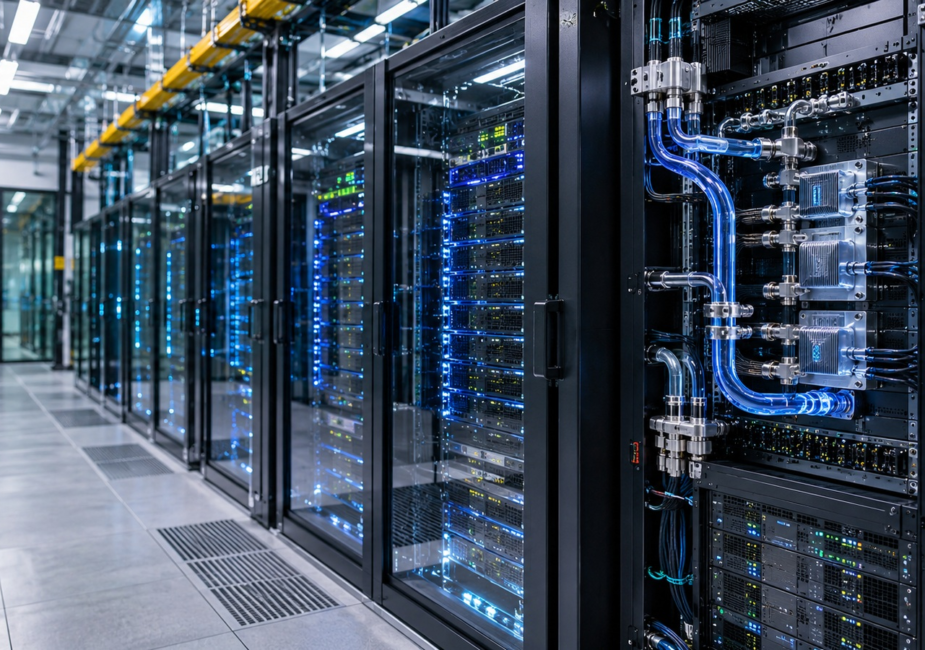
Why cooling has become a commercial market
As computing systems become more power-intensive, managing the heat they produce is an increasingly visible part of infrastructure economics. Liquid cooling is not a single product: it encompasses cold plates, pumps, manifolds, heat exchangers, piping, sensors, leak detection and the operational services that support them. That variety matters because it creates opportunities for specialized companies at several points in the supply chain.
Products are only one part of the value
A component manufacturer may sell a reliable pump, but the facility operator needs a complete system that works with server hardware, maintenance procedures and monitoring tools. Integration services can therefore be commercially valuable. Customers want clear documentation, predictable performance and a plan for handling faults. Suppliers that provide testing, commissioning and ongoing support may build longer-lasting relationships than firms competing on hardware price alone.
The importance of reliability
A cooling problem can interrupt expensive computing workloads. This raises the value of preventive maintenance, component quality and operational visibility. Businesses in the sector need to think about spare parts, response times, service agreements and staff training from the beginning. Technical claims should be validated through appropriate engineering testing. Marketing language about efficiency or uptime is not a substitute for documented performance under relevant operating conditions.
The economics of a specialized supplier
Consider a hypothetical firm that sells monitoring and maintenance services to ten facilities at $4,000 per month each. That would produce $40,000 in monthly service revenue before staff, insurance, travel, software and equipment costs. It is an illustration rather than an industry average. Actual contracts may be far larger or smaller depending on site complexity and responsibility. The key business metric is contribution after the direct cost of meeting each service commitment.
Barriers to entry
Liquid-cooling projects may involve pressurized fluids, electrical systems, warranties and high-value computing equipment. Operators will expect trained personnel, insurance, careful procedures and compliance with applicable standards. An inexperienced company should not present itself as qualified to engineer or install critical infrastructure without the necessary credentials. A more realistic entry route may be distribution, documentation, monitoring support or partnering with established engineering contractors.
Where competitive advantage develops
The strongest suppliers may differentiate through rapid replacement logistics, accurate monitoring, compatibility testing and excellent service records. Customers are likely to value partners that can reduce operational uncertainty. As the market evolves, firms that keep detailed performance data and respond quickly to failures can build a reputation that is difficult for a low-price competitor to replicate.
Last modified: November 18, 2026