

The Semiconductor Industry Is Entering a New Scale of Growth — and a More Competitive Supply-Chain Era

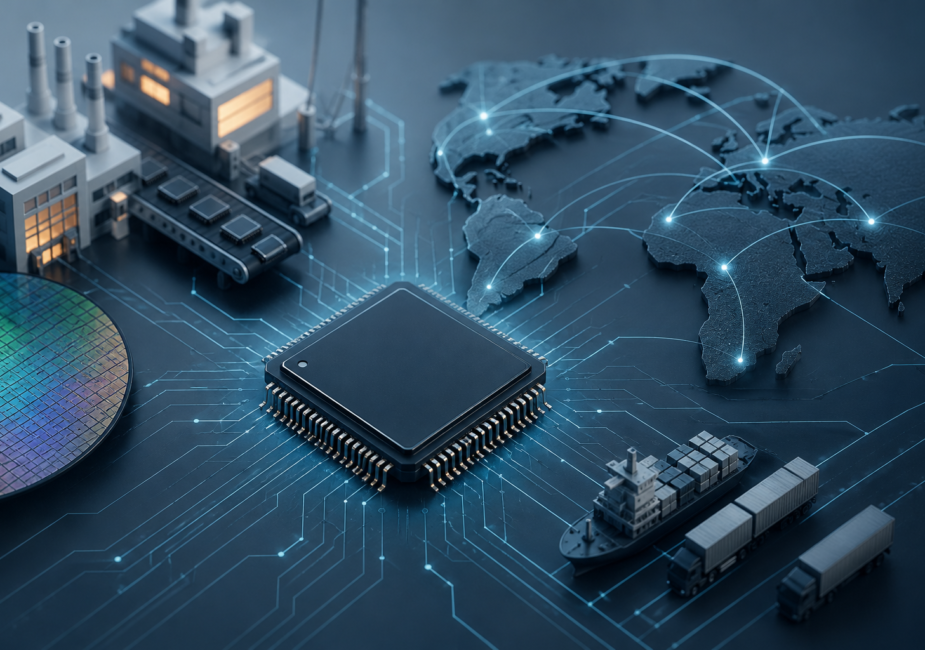
The global semiconductor industry is entering 2026 at a scale that would have seemed extraordinary only a few years ago. The Semiconductor Industry Association reported that worldwide chip sales reached $120.6 billion in May 2026, a record monthly level in its series, up 9.2% from April and 104.1% from May 2025. Its July 2026 State of the Industry report said global semiconductor sales reached $795.6 billion in 2025 and cited a World Semiconductor Trade Statistics projection of $1.5 trillion for 2026. The figures illustrate how quickly artificial intelligence and advanced computing are expanding the economic importance of chips.
AI is one of the most visible drivers, but the opportunity is broader than AI accelerators. Semiconductors are increasingly embedded in data centers, vehicles, industrial equipment, communications systems, healthcare devices and defense platforms. That diversification creates several demand pools rather than leaving the industry dependent on one application.
The supply chain is consequently becoming a strategic asset. Semiconductor manufacturing requires enormous capital expenditure, specialized equipment, advanced process technology, skilled engineers and reliable access to materials and energy. Governments in the United States, Europe and Asia are therefore pursuing policies designed to increase domestic or regional manufacturing capacity. The objective is not to eliminate global trade, but to reduce the consequences of concentrated production and improve resilience in strategically important technologies.
For semiconductor companies, the growth opportunity comes with a difficult capital-allocation problem. Building a leading-edge fabrication plant can require billions of dollars and years of development before capacity becomes productive. Companies must therefore make long-range decisions about technology nodes and customer demand while the market can change rapidly. The current AI boom makes capacity expansion attractive, but the strongest operators will still need disciplined forecasting because semiconductor cycles historically move between shortages and periods of excess supply.
The competitive landscape is also changing. The industry increasingly rewards companies that can control a critical part of the stack, whether that means chip design, advanced manufacturing, memory, packaging, networking or specialized equipment. TSMC’s second-quarter 2026 results illustrate the strength of leading-edge manufacturing demand: revenue reached $40.20 billion, while management guided third-quarter revenue to $44.6 billion to $45.8 billion. Advanced technologies accounted for 77% of wafer revenue in the quarter.
Geopolitics adds another layer of complexity. Export controls, industrial subsidies, technology restrictions and national-security concerns can influence where chips are designed, manufactured and sold. Companies that diversify production and maintain strong relationships across regions may have an advantage, but diversification is expensive. The result is an industry where supply-chain strategy has become part of corporate strategy rather than a back-office procurement issue.
For entrepreneurs, the semiconductor boom creates opportunities outside chip manufacturing itself. Equipment maintenance, specialty materials, industrial software, quality assurance, logistics, clean-room services, workforce training and compliance support can all benefit from fab and data-center investment. Businesses that provide the infrastructure, services and specialized expertise needed by semiconductor companies can participate in the growth without taking on the enormous capital requirements of building a fabrication plant.
Semiconductor cyclicality Semiconductor fab construction Semiconductor future growth Semiconductor Insights Semiconductor market trends
Last modified: August 19, 2026