

What is Artificial Intelligence (AI)?


Basic understanding of Artificial Intelligence
Artificial intelligence, abbreviated as AI, is a field of modern technology that provides computers and machines with capabilities similar to human intelligence. With its help, machines can understand information, learn from experiences, analyze problems, make decisions, and in some situations, even perform tasks autonomously.
How is AI used in our daily lives?
Today, artificial intelligence is no longer limited to laboratories but has become an important part of our daily lives. AI-powered systems can identify objects in images, understand human language and respond, improve themselves with new information, and also provide useful suggestions according to user needs.
Many modern technologies, such as self-driving cars, are capable of making different decisions without human intervention, which is a practical example of artificial intelligence.
Why is generative AI important?
Generative AI has received the most attention in the world of artificial intelligence in recent years. This technology not only analyzes information, but can also generate new text, images, videos, audio and other creative content according to user instructions.
However, to fully understand generative AI, it is first necessary to know the basic technologies on which this system is based, of which machine learning and deep learning are the most prominent.
What is machine learning?
The foundation of AI
Machine learning is one of the basic branches of artificial intelligence. Its goal is to enable computers to learn from data themselves, recognize patterns and predict future outcomes or decisions, instead of manual programming.
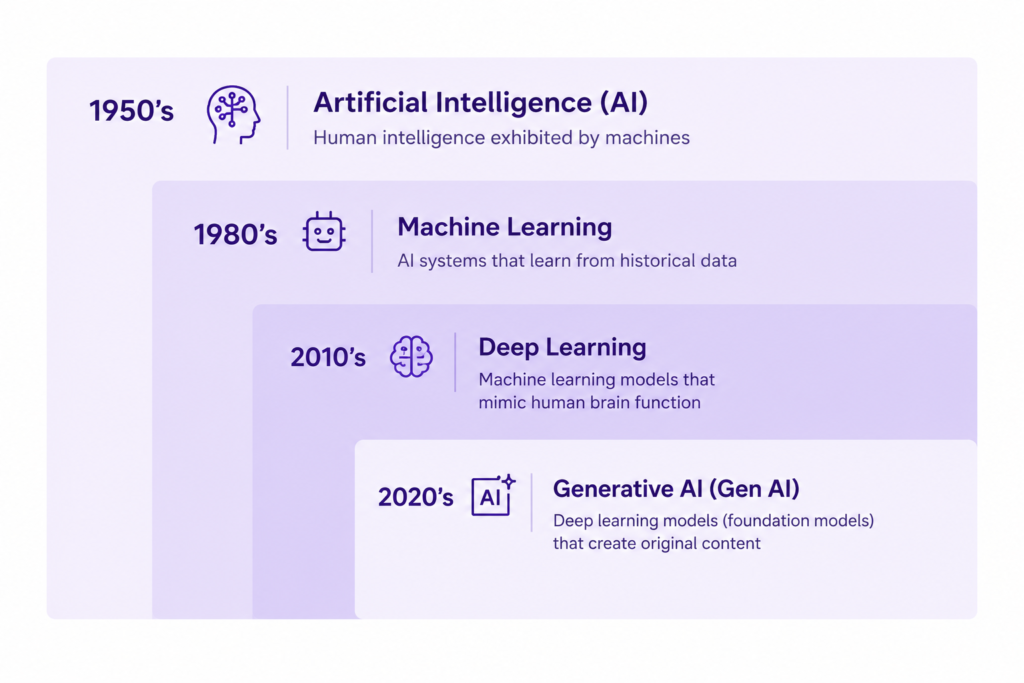
This method is based on various algorithms and mathematical models, with the help of which computers analyze large amounts of information and draw better conclusions.
Important Algorithms of Machine Learning
Several algorithms are used in machine learning to solve different problems, including:
Linear Regression
Logistic Regression
Decision Trees
Random Forest
Support Vector Machines (SVM)
K-Nearest Neighbor (KNN)
Clustering
Each algorithm is designed for a specific type of data and different business or scientific problems, so they are selected according to the need.
What is a Neural Network?
Neural Network is considered one of the most effective techniques in machine learning. Its structure is inspired by the human brain, where different nodes are connected to each other and analyze information.
These networks have the ability to discover relationships, trends, and hidden patterns in complex data, which is why they are widely used in image recognition, language understanding, and other advanced AI applications.
Deep Learning: The Modern Basis of Artificial Intelligence
What is Deep Learning?
Deep learning is a modern branch of artificial intelligence that makes machine learning more powerful. This technology uses deep neural networks that analyze information in the manner of the human brain and are capable of making complex decisions.
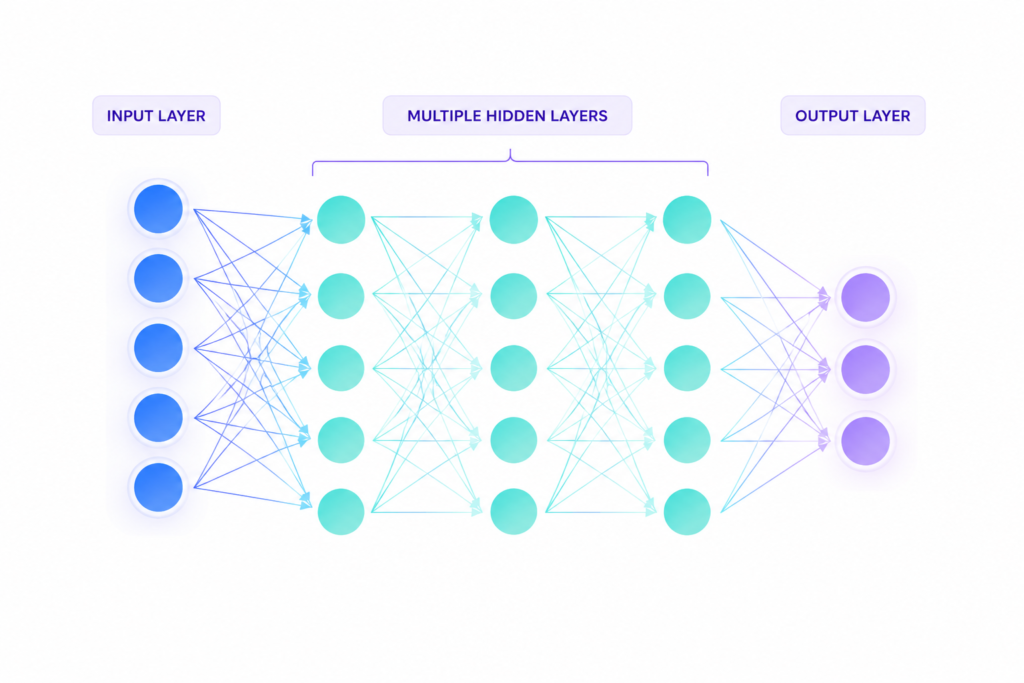
How do deep neural networks work?
Compared to traditional neural networks, deep neural networks consist of several layers. They include an initial input layer, several hidden layers, and finally an output layer.
All these layers analyze information step by step, thanks to which the computer is able to understand the relationships and patterns in complex data more accurately.
Ability to learn without human intervention
The most striking feature of deep learning is that it can automatically obtain information even from unstructured and unlabeled data. It does not require human guidance at every stage, but rather continuously improves its performance by analyzing data.
Due to this feature, deep learning has the ability to learn quickly from a large amount of available information.
In which fields is it used?
Deep learning has become the basis of today’s modern AI applications. It is used in natural language understanding, image and video recognition, voice analysis, and other complex tasks.
Whenever a system needs to draw accurate conclusions from a large amount of information or find hidden patterns, deep learning is the best choice.
Main types of deep learning
Semi-Supervised Learning
In this method, AI is trained with two different types of data. One is information that already has labels, and the other is information that does not have any labels. By combining the two, the accuracy and learning speed of the model are improved.
Self-Supervised Learning
In this technique, AI does not rely on any external labels, but completes its training by obtaining the necessary signals from the available information itself, which can achieve effective results even on less labeled data.
Reinforcement Learning
In this method, artificial intelligence learns through experiments. It gets rewarded for correct decisions, while learning from incorrect decisions and adopting better strategies in the future. This process of continuous testing and improvement increases its performance.
Transfer Learning
Transfer learning is a technique in which AI applies previously acquired knowledge to a new but similar problem. This reduces the need to retrain new models from scratch and better results can be achieved in less time.
What is Generative AI?
The beginning of new creativity
Generative AI is a modern form of artificial intelligence that not only analyzes information but can also create completely new content. It is capable of generating detailed articles, quality images, realistic videos, audio, music, and other creative content based on user instructions.
How does generative AI work?
This technology first learns basic information, patterns, and relationships from its training data, then uses them to generate new content that is inspired by the original information but does not replicate it.
That is why ChatGPT, image creation tools, and other advanced AI systems are able to produce unique and novel results based on human instructions.
Basic AI Technologies
What models does modern AI build on?
Behind the extraordinary development of generative AI are several advanced deep learning models. Over time, these technologies have not limited artificial intelligence to understanding information, but also enabled it to generate new and creative content. Most AI systems used today work on the basis of these advanced models.
Variational Autoencoders (VAEs)
Introduced in 2013, Variational Autoencoders (VAEs) played a significant role in the development of generative AI. These models can generate unique content of different styles based on a single instruction, which makes it easier to achieve creative results.
Diffusion Models
After this, Diffusion Models came out, which further improved the way images are created. They first completely convert an image into noise and then gradually remove this noise to create a completely new image.
Thanks to this technique, today’s modern AI image generators are able to produce images that are close to reality and of high quality.
Transformer Models
The most widely used technology in modern AI is Transformer Models. These models analyze existing information in depth sequentially and then generate new text, images, videos or programming code based on this.
This technology has led to the emergence of famous AI platforms such as ChatGPT, GPT-4, Microsoft Copilot, BERT, Bard and Midjourney and has become popular worldwide.
How does generative AI work?
The complete creation process
Although the performance of different AI platforms may vary, most generative AI systems follow a common methodology. This process mainly consists of three steps:
Training the basic model
Improvement of the model according to a specific goal
Content preparation and continuous optimization
These steps make AI more accurate, reliable and effective.
The importance of the foundation model
Every modern generative AI system is based on a foundation model. This basic model is later used for various applications and services.
The most popular foundation models currently are Large Language Models (LLMs), which specialize in generating text. In addition, there are separate foundation models for images, videos, audio and music, while some modern models can work on multiple types of content simultaneously.
How is AI trained?
To develop a foundation model, AI is trained on a large amount of data obtained from the Internet and other sources. This data includes written content, images, videos and other unstructured information.
During training, the AI understands the patterns, relationships and structure present in this information, so that it can later automatically generate new and relevant content according to user instructions.
Why is the training process expensive?
Developing modern AI models is not an easy task. Thousands of powerful Graphics Processing Units (GPUs) are used for this and the entire process can last for weeks or sometimes months.
For this reason, developing a robust foundation model can cost millions of dollars, which is why only large technology companies can invest in such projects.
The importance of open source models
With the rapid development of AI, several open source foundation models have also been introduced, of which Meta’s Llama-2 is a prominent example.
Thanks to these models, developers do not need to develop a new model from scratch every time, but can develop advanced AI applications in less time and at lower cost by improving pre-trained models according to their needs.
Advantages of artificial intelligence Artificial Intelligence (AI) Best definition of artificial intelligence What is artificial intelligence in simple words What is artificial intelligence with examples
Last modified: July 26, 2026


[…] Artificial intelligence is reshaping the workplace faster and in more profound ways than many businesses anticipated. In 2026, AI is no longer an end-technology that only tech companies adopt. Small businesses, shops, marketers, financial analysts, customer officers, lawyers, accountants, and other industries apply artificial intelligence in day-to-day operations to automate routine processes and make their employees more productive. As a result, businesses rethink the mix of talents they seek in the modern worker. […]
[…] rise of artificial intelligence and automation means that businesses offer more digital services online. Customers are exposed to […]
[…] Artificial intelligence tools are helping small teams accomplish this task, by handling busy-work tasks such as writing, researching, organizing, summarizing, ideation, and more. What these tools lack, however, is a clear answer as to what their place in the workplace should be. […]